
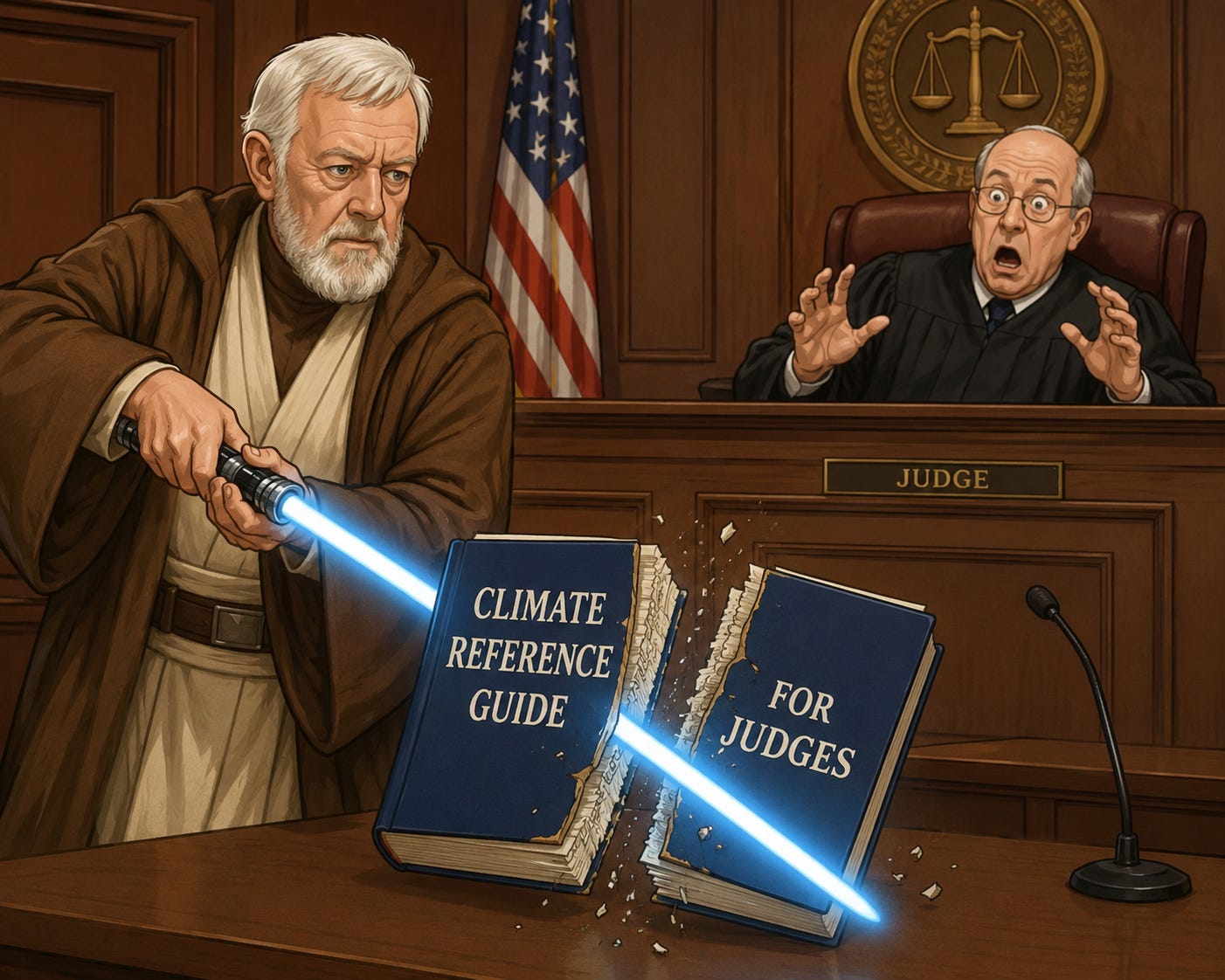
In the first four parts of this series, I went through the many serious problems in the climate reference guide. These problems can’t be addressed by simply editing the document. Even if those problems were corrected, the guide would be still be incomplete because it omits discussion of most of the climate models and methodologies that judges are likely to see in real cases. Thus, the climate reference guide will need to be re-written from the ground up. Here are the changes I’d recommend in the final installment of this series.
Issues That Need To Be Corrected
Remove Discussion and Reliance on IPCC Ratings
Part 1 showed that IPCC ratings are designed for policy purposes and can’t be shoehorned into the legal process. They are highly misleading when used for purposes for which they were not designed. Unfortunately, much of the guide is devoted to reviewing IPCC views and ratings. That material should be removed from an updated reference guide.
Correct The Statistical Fallacies in the Climate Reference Guide
Part 2 of this series reviewed the many errors and statistical fallacies in the section on interpretation of statistical evidence. The updated guide needs to correct those errors. That errors of that magnitude could get through to publication strongly indicates the guide was not properly vetted or checked, calling into question everything else. The re-written guide needs to be thoroughly reviewed for errors and mistakes.
Remove the Bias in Favor of Plaintiffs in the Discussion on Admissibility of Climate Evidence
Part 3 of this series showed that the reference guide essentially presented the plaintiff’s expert’s argument in the undecided Juliana v United States case as settled law that judges should follow. The re-written guide should take an objective, neutral view on admissibility of climate science evidence, reviewing both sides of the argument without taking sides.
Recognize that Published Research in Climate Economics Can Be Badly Wrong
In real cases, judges are very likely to see expert testimony that combines climate science with economics or econometrics. The new climate attribution methodologies mentioned in part 4 attempt to link an actor’s emissions to economic damage or losses caused ultimately by those emissions. As part 4 clarified, those new methodologies depend crucially on economic damage functions, which are estimated by econometric methods developed by economists.
Economic damage function research is a rapidly growing academic area, but there is no consensus at this point. Researchers can get radically different economic damage estimates depending on the assumptions and econometric techniques they use. Part 4 showed as well that sometimes these methodologies can be blatantly wrong and judges should not assume that the academic publication process will correct those errors. Research in climate economics and econometrics should be independently replicated and model validated as part of the evidentiary process.
Climate Models and Methodologies Discussion That Should Be Added
The updated reference guide should include a full discussion of climate economics and econometrics along with recent models that use them, such as Carbon majors and the scientific case for climate liability
Models Used By Banks and Insurance Companies
The insurance and financial service industries are affected by climate change and thus must confront the same issues that arise in climate suits. For example, insurance companies need to understand the effect of climate change on the residential and commercial buildings they insure. Banks, because they lend to support the purchase of real estate, also need to understand the effect of climate change on the value of the real estate loan collateral as well as on the ability and willingness to pay back loans.
To support banks and insurance companies, a sophisticated catastrophe model industry has arisen. In the last few years, these models have been augmented to include the effects of climate change. It’s highly likely that judges will see the results of these models in climate cases. Strangely, however, there is no mention of these extremely important climate models in the reference guide.
Catastrophe Models
Having been around for at least a decade, catastrophe models were originally developed for the insurance industry to measure the effect of extreme weather effects on the property they insure. Recently, these models have been modified to include the effects of climate change on extreme weather events. Banks are now adopting them as well to use in their climate risk management programs.
Catastrophe models attempt to model extreme weather events. The models they use are domain specific and not really covered by IPCC documents. Here are some examples of some of the most important catastrophe models.
Wildfire Models
Wildfire models rely on the academic field of fire science. They aim to do a full simulation of a wildfire from ignition to property damage.
The ignition models are often statistical and will depend on factors such as the distance to the nearest road, since so many wildfires are started by humans. But the ignition models will also depend on the fuel density, the season, and the weather.
Once there is ignition, a wildfire model must simulate how the fire will spread, which depends on exact details such as the available canopy, the topography, and, very importantly, the fuel that propels the fire. The fuel sources are such things as grass, grass shrub, timber understory, timber litter, and shrub. In all, there are generally 40 fuel types in a wildfire model and fire spread will depend on the exact details of the fuel in the area that the wildfire may burn. The spread model will also depend on suppression, which controls how far a wildfire can burn into an urban environment. Suppression, is of course, a policy choice and is highly dependent on flame length and the weather.
The wildfire model will need to simulate flame length. To do so, it will rely on results in fire science, such as Alexander's model. The model will also use damage functions to estimate building and other damage from the wildfire. These functions will depend on flame length and other attributes of the wildfire model.
Flood Models
Flood modeling is a specialized academic field that applies hydrodynamics to the study of floods. The models used by insurance companies and banks attempt to simulate floods and the consequent damage they cause to property.
The models take rainfall and other water inputs, such as evaporation, and then combine it with a digital elevation model (DEM), land use, friction and flow resistance, infrastructure, and drainage.
Flood models generally solve some simplified version of the Navier Stokes equations, the so-called shallow water equations, which govern how the flood progresses, subject to the water inputs and details of the topography and other features of the flood area.
To calculate flood damage to buildings, the model will need to rely on damage functions. The damage functions are complex functions that depend on the exact details of the buildings as well as the height of the flood. One set of damage functions that may be used are the HAZUS damage functions.
Hurricane Models
Hurricane models are probably the most complicated catastrophe models. They may be physics-based models, statistical models, or some hybrid. Just to give one example of the complexity, the model will need to project wind speed precisely. The reason is that damage to buildings depends on at least the cube of the windspeed by basic physics principles, but empirically wind damage turns out to be even more nonlinear. Small changes in wind speed produce large changes in damage, so accuracy is important.
To simulate windspeed, the hurricane model will need to describe the eye of the hurricane. At the center of the eye, wind speed is lowest. However, the windspeed increases rapidly on the right side of the eye, reaching a maximum and then falling off. The windspeed is asymmetric: on the left side of the eye, winds are much weaker.
Estimating damage from hurricanes is enormously difficult, because the model must know the exact details of each building and the buildings, structures, and other objects around it. Damage functions for wind can run into hundreds of pages of possibilities for all permutations of construction types. Worse, hurricane cause floods, so the wind model must be combined with a flood model and flood damage functions, which also depend on exact details of the building structure along with flood height. Hurricane models also need a model for the genesis point over the sea, a model for the dynamics of the track, a storm surge model, a model for progression over land, and a precipitation model.
Climate Enhanced Catastrophe Models
Originally, these models were developed as extreme weather models that didn’t include the effects of climate change. But recently they have been augmented to include climate change. The basic models didn’t change; rather, some aspect of the model or input was modified for the effects of climate change. For example, in a hurricane catastrophe model, the starting sea surface temperature could be raised, since higher sea surface temperatures produce stronger hurricanes. To take another example, in a flood model the input rain water could be increased to correspond to increased precipitation from climate change. Increasing the rain input will make the flood, and thus building damage, more severe.
Climate enhanced catastrophe models are offered by vendors and consulting companies for use in insurance company and bank climate risk management programs. For example, S&P offers a complete suite of climate enhanced catastrophe models to its financial services clients.
It’s only a matter of time before climate catastrophe models start to show up in the courtroom. An updated climate reference guide should cover them.
Summary
The necessary changes and additions I’ve outlined in this post are too extensive to be addressed by simply editing the current reference guide. The climate reference guide needs to be completely re-written. To recap, an updated climate reference guide for judges should
eliminate reliance on the IPCC and its ratings
correct statistical mistakes and fallacies
include a balanced discussion of the issues surrounding admissibility of climate science evidence
discuss climate economics and econometrics and emphasize the importance of independently replicating and validating that evidence
include a full discussion of climate enhanced catastrophe models.
If NASEM doesn’t update the climate guide in the Reference Manual on Scientific Evidence, I hope this 5-part series can serve as an alternative guide and resource.